
Artificial intelligence is changing how people discover video content. Traditional YouTube SEO focused on ranking inside YouTube search results.
Today, AI systems generate direct answers and often cite sources inside those answers. If your video is cited, you gain authority, traffic, and qualified viewers. If it is not cited, your competitors fill the gap.
Recent analysis of 1,200 prompts across ChatGPT, Perplexity AI, and Google Gemini found that 62 percent of brands never appear in AI-generated answers.
The average brand visibility score was only 27 out of 100. When a brand was missing, competitors received 65 percent of the citations. This means visibility in AI search is not optional. It is a competitive requirement.
AI Search for Youtube Content Creators
AI search is different from traditional keyword ranking. Instead of showing a list of blue links, AI systems synthesize information from multiple sources and then provide summarized answers. These answers often include references to YouTube videos, Reddit discussions, Wikipedia pages, and review platforms.
For youtube content creators, this shift creates a new opportunity.
AI-driven answers usually appear for high-intent queries such as tutorials, comparisons, and problem-solving questions. When your video is cited, it reaches users who are actively looking for a solution. This traffic converts better because the viewer already trusts the AI’s recommendation.
YouTube remains the second-largest search engine in the world. According to recent platform data, over 500 hours of video are uploaded every minute. That level of competition means visibility must be engineered strategically. AI search gives creators a new distribution channel, but only if the content is structured correctly for machine interpretation.
YouTube and Reddit are cited more by AI than your own website
The data reveals a key pattern. AI models prioritize content that appears in conversations they do not control. Brands that scored above 70 in AI visibility shared one common factor. They were mentioned in Reddit threads, YouTube comparisons, and third-party reviews.
Traditional SEO metrics like backlink volume and domain authority alone did not strongly correlate with AI visibility. Paid ads and social media followers showed little effect on citation frequency. What mattered was authentic discussion and structured information.
YouTube Overtakes Reddit as Go-To Citation Source on AI Search
Recent visibility tests show that YouTube and Reddit appear in almost every AI citation run. Brand websites appear far less often.
Top cited sources across AI platforms include:
- YouTube
- Wikipedia
- G2
- Forbes
- Capterra
Why does YouTube outperform brand blogs?
YouTube videos often function as independent explanations, reviews, and comparisons. AI systems prefer sources that resemble neutral information rather than direct marketing material. Public discussions and independent reviews provide contextual signals that feel more trustworthy.
How AI Cites YouTube
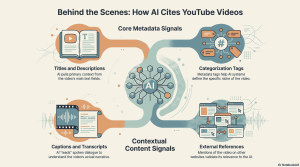
AI systems do not watch videos like humans. They extract text and context signals. When an AI cites YouTube, it usually pulls from the following sources:
- Video titles
- Descriptions
- Tags
- Captions and transcripts
- External references to the video
Platforms like Perplexity frequently provide direct video citations for tutorial queries. Google AI Overviews include video thumbnails and links when the content answers a specific question clearly. ChatGPT increasingly references YouTube videos when the transcript provides structured, factual information.
This means the video must contain clear language and strong semantic alignment with user queries. If your transcript includes direct answer statements, the AI can quote them. If your metadata is vague, the AI cannot interpret your relevance confidently.
AI does not watch videos like humans do. Instead, it reads the textual and contextual signals around the video. Below is a clear breakdown of exactly how that works and what each step means in practice.
Step 1 — AI reads the Video Title first
- The video’s title is the first and most visible text associated with your video.
- AI systems look for a title that clearly matches a user question or intent.
- Because YouTube dominates AI citations (being 200× more cited than other video platforms) AI treats YouTube video titles as high-value clues for what the video is about.
Actionable tip:
Write video titles that mirror real questions people ask, such as:
- “How to optimize YouTube videos for AI search”
- “How AI reads video content”
- “How to get your videos cited by ChatGPT”
Clear titles help both YouTube users and AI engines understand your topic instantly.
Step 2 — AI scans the Description text
- After the title, AI reads the description below your video.
- This descriptive text provides context about what the video covers in natural language.
- AI uses this language to connect the video to the user query rather than guessing based on title keywords alone.
A good description does three things:
- Restates the main points clearly
- Includes variations of the target query
- Uses relevant keywords naturally
Actionable tip:
Write a long, structured description (at least 300–500 words) that explains what the video covers, adds semantic context, and naturally includes target keywords.
Step 3 — AI looks at Tags as supporting signals
- Tags help reinforce the topic signals from your title and description.
- AI treats tags as additional semantic markers, not as ranking drivers on their own.
They provide context diversification. - AI systems like Perplexity and similar search engines rely on tags to better map your video content.
Actionable tip:
Use tags that include:
- Variations of your main query
- Common synonyms related to the topic
- Related concepts, e.g., “AI citation optimization,” “YouTube SEM,” “Generative Engine Optimization”
Tags widen the semantic net, helping AI engines match your video to more queries.
Step 4 — AI uses Captions and Transcripts as core text
This is the most important step for AI to actually read the content of your video.
How this works:
- Captions are the written text that YouTube auto-generates or you upload manually.
- Transcripts are the full text version of spoken content.
- AI engines extract this text and use it as the primary source for answering questions.
Because video transcripts provide real words spoken in the video, they often become the exact sentences AI will quote or cite in an answer. That is why AI tools increasingly reference video transcripts in their summaries and answers.
Actionable steps:
- Enable auto-captions in YouTube settings.
- Export the transcript and clean errors (especially technical terms).
- Publish the cleaned transcript on your site (more on this later).
Step 5 — AI detects External references to your video
AI models do not only read YouTube itself. They also read how your video is referenced externally:
✔ Embedded on blogs
✔ Linked in Reddit threads
✔ Quoted in answer sites
✔ Cited in third-party reviews
When other sites reference your video, AI treats those mentions as independent evidence of relevance and authority. This helps AI feel confident citing your video within its answer.
For example, AI citation studies show that YouTube content that appears in external contexts like Reddit or blogs is more likely to be cited because the engine sees multiple independent “trust signals.” (VEED.IO)
Step 6 — How AI combines all signals to generate a citation
Once AI has all of the above text sources, it uses them together to decide whether your video should be cited.
What it evaluates:
- Semantic match to the query:
Does the text (titles + description + transcript) answer the question? - Trust signals:
How many independent references connect to the video? - Content clarity:
Does the transcript contain clear answer sentences?
AI algorithms synthesize these elements and then decide which sources to include in its final output.
Different platforms use slightly different logic:
📌 Perplexity:
Retrieves live web content and synthesizes concise answers with citations. It will often list YouTube video URLs directly as references.
📌 Google AI Overviews:
Uses rich structured data (including transcripts) to include video thumbnails and links when the content fully satisfies the user’s question.
📌 ChatGPT:
References videos whose transcripts and external references strongly match user intent—especially for how-to queries.
Step 7 — Speech must align with user questions
If your transcript explicitly contains concise answers to questions that users commonly ask, AI can quote it directly.
For example, if someone queries:
“How AI reads video content,”
and your transcript includes:
“AI reads video content by extracting the transcript text and matching it to the user’s question…”
AI can lift that sentence as a direct answer.
This is why clear answer sentences matter more than clever storytelling or vague wording.
Step 8 — AI citation quality also depends on user intent
AI engines favor certain types of content for citation:
Higher likelihood of citation:
✔ Tutorials
✔ Step-by-step instructions
✔ Educational breakdowns
✔ Definitions
✔ Comparisons
Lower likelihood of citation:
✘ Pure branding
✘ Vague or metaphorical language
✘ Short entertainment format
✘ Content that lacks transcript clarity
Structured explanation content performs better for AI because it is easier to extract factual information.
Step 9 — Publish the transcript on your own site
AI visibility increases dramatically when the clean transcript is published on a crawlable web page alongside the video. Many AI engines index the transcript text in the same way they would a blog article.
Publishing the transcript does two things:
- It provides a text version AI can crawl outside of YouTube.
- It creates a content asset that can be linked, shared, and discussed independently.
This multiplies citation opportunities because AI engines can find your video text outside of YouTube in searchable web pages.
Summary: How AI Cites YouTube — Step by Step
Here is the simplified workflow AI uses to cite YouTube videos:
- Reads the video title to understand topic and intent
- Scans the description to add more context
- Considers tags as semantic support
- Extracts captions and transcripts as primary text source
- Finds external references to strengthen authority
- Matches all text to the query for relevance
- Quotes clear answer sentences from transcript
- Prefers educational and structured content
- Indexes your transcript on crawlable pages when available
AI only cites video content it understands and can match to user intent with confidence. The clearer, more structured, and more widely referenced your video text environment is, the more likely AI is to cite it in responses.
How to Optimize Video Keywords and Titles for AI Search
Start with question alignment. Instead of vague branding titles, use direct question formats such as:
- How to optimize YouTube videos for AI search
- How do I get my YouTube video to show up in search?
- How to increase visibility in AI search?
These titles match real user intent. AI systems detect semantic similarity between the question asked and the video title.
Next, include related keywords naturally inside descriptions:
- AI Search for Video Creators
- Getting your YouTube videos recommended in AI Search for organic growth
- How AI Cites YouTube
- How to Get Your Videos Cited by ChatGPT and other AIs in their responses
Avoid keyword stuffing. Write naturally but ensure semantic coverage.
Getting Your YouTube Videos Recommended in AI Search for Organic Growth
If you want your videos to be recommended inside AI-generated answers, you must understand one core principle:
AI systems recommend content they can confidently understand, extract, and validate.
Modern AI search systems do not randomly pick videos. They follow a structured retrieval process:
- Interpret the user’s question
- Break it into multiple sub-queries
- Retrieve high-confidence matches
- Evaluate clarity and authority
- Surface the most reliable answer
To increase your recommendation chances in AI Search for organic growth, you must optimize across multiple layers: content clarity, structure, metadata, and external signals.
Below is a practical, proven framework.
Step 1: Answer Specific Questions Clearly in the First Minute
AI systems prioritize content that directly answers a query.
When someone asks:
- How to optimize YouTube videos for AI search?
- How do I get my YouTube video cited by AI?
- How to increase visibility in AI search?
The AI looks for content that contains a direct answer sentence early in the transcript.
Most AI systems prioritize:
- Early transcript content
- Summary-style statements
- Clear definitions
If your video begins with long storytelling or vague introductions, the AI may struggle to extract a concise answer.
Instead, begin like this:
“In this video, I will show you how to get your YouTube videos recommended in AI search by optimizing titles, transcripts, and external mentions.”
That sentence is extractable.
Implementation checklist
- State the exact question you are answering.
- Provide a concise 1–2 sentence answer.
- Then expand with detail.
This improves match probability during query fan-out retrieval.
Step 2: Include Timestamps for Key Sections
Timestamps improve both human usability and AI retrieval.
AI systems prefer structured content.
When your description includes:
00:00 – What is AI Search?
01:10 – Why YouTube overtakes Reddit
03:45 – How AI reads video transcripts
06:20 – Optimization strategy
You are doing two things:
- Improving viewer experience
- Creating structured text segments
AI engines can associate timestamp headings with specific subtopics. This makes it easier for them to cite a specific portion of your video.
AI systems sometimes surface direct timestamp links when:
- A specific section answers the query clearly
- The structure is obvious
- The topic segmentation is clean
Without timestamps, your transcript appears as one long block of text. With timestamps, it becomes organized knowledge.
Step 3: Repeat Important Definitions in Both Speech and Text
Redundancy increases clarity.
If you define:
“AI Search for Video Creators is the process of optimizing video content so AI systems can read and cite it.”
You should:
- Say it clearly in the video
- Include it in the transcript
- Add it in the description
AI systems compare signals across:
- Title
- Description
- Transcript
- Metadata
- External references
When the same concept appears consistently across these layers, AI confidence increases.
AI models reduce uncertainty by looking for reinforcement.
If your title says “AI Search Optimization,” but your transcript never mentions it clearly, relevance weakens.
Consistency strengthens retrieval.
Step 4: Embed the Video in a Related Blog Post
This step dramatically increases citation probability.
When you embed a YouTube video inside a blog post:
- You create crawlable text context.
- You provide structured headings.
- You add additional semantic reinforcement.
- You can implement schema markup.
AI systems read web pages more easily than video platforms alone.
Your blog post should include:
- A keyword-optimized H1
- Structured H2 and H3 sections
- A clean transcript
- A summary section
- Relevant internal links
When AI scans the web for supporting information, it finds both:
- The YouTube video
- The text-based version
This dual-layer presence increases visibility.
Step 5: Encourage Organic Mentions in Public Forums
AI systems rely heavily on publicly available data.
When your video appears in:
- Reddit discussions
- Industry forums
- Blog citations
- LinkedIn posts
- Comparison threads
It gains contextual authority.
AI models are trained on large volumes of public discussion data.
If your video is referenced in authentic conversations, it appears more trustworthy.
However, this must be organic.
Avoid:
- Spam posting
- Forced promotion
- Artificial engagement
Instead:
- Answer real questions.
- Share helpful insights.
- Link to your video naturally when relevant.
The goal is ecosystem visibility, not aggressive promotion.
How AI Models Interpret Recommendation Signals
To understand why this framework works, it helps to understand how AI systems process content.
AI engines perform what is known as retrieval augmentation.
They:
- Break a prompt into multiple sub-queries.
- Retrieve documents or transcripts matching those queries.
- Rank them based on relevance and clarity.
- Synthesize an answer.
The stronger your signals across:
- Keyword alignment
- Transcript clarity
- Structured formatting
- External authority
The more your video appears in valuable contexts, the stronger the signal.
Consistency across content layers transforms your video from media into structured knowledge.
AI-driven traffic may convert better because users have higher intent. This can reduce the number of views required through affiliate revenue or lead generation.
FAQs
What kind of content gets cited most often by ChatGPT or Perplexity?
Content cited most often includes:
- Tutorials
- Buying guides
- Industry explainers
- Technical walkthroughs
- Balanced comparisons
Educational tone performs better than hype. AI systems prefer clarity and neutrality.
How do I get my YouTube video to show up in search?
For YouTube search:
- Use clear keyword-aligned titles
- Add 300 to 500 word descriptions
- Include timestamps
- Improve watch time above 50 percent retention
For AI search:
- Publish transcripts
- Encourage public discussion
- Structure answers clearly
- Add schema markup
Can AI help me find a YouTube video?
Yes. AI systems increasingly recommend YouTube videos directly within answers. They extract summaries and sometimes link to timestamps. Optimized videos become discoverable beyond YouTube’s internal search engine.
How to make AI read YouTube videos?
AI reads YouTube videos through textual layers. Make sure every video includes:
- Clean transcript
- Detailed description
- Logical chapters
- External embedding with schema
This transforms video into structured knowledge.
How to increase visibility in AI search?
Visibility equals citation frequency multiplied by authority context.
Increase authority by:
- Publishing evergreen guides
- Creating comparison content
- Encouraging independent reviews
- Building discussion footprints
Avoid relying only on backlinks or paid ads. Organic discussion and structured data have stronger correlation with AI visibility.