
Artificial intelligence is changing how people search. According to a report by Neil Patel, around 60 % of searches now end without a click, with answer engines such as ChatGPT, Perplexity, and Google’s AI summaries delivering answers directly to users.
Instead of clicking ten links, users now ask tools like ChatGPT, Google Gemini, Perplexity AI, and Amazon Alexa for direct answers.
If your business is not inside those answers, you lose visibility before customers even see search results. This is why Answer Engine Optimization (AEO) matters in 2026.
This guide is written for mid-market business owners who want to:
- Increase Higher AI Visibility in Marketplaces & Search
- Reduce ad spend
- Get cited in AI answers
- Generate more qualified leads
You will learn what AEO is, how it differs from SEO, how AI engines choose what to show and cite, and how to implement the core answer engine optimization framework the right way.
What is AEO (Answer Engine Optimization)?
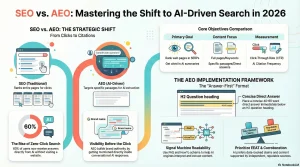
AEO means Answer Engine Optimization. This is the process of structuring and optimizing content so AI-powered systems can understand it, trust it, and include it in generated answers.
Unlike traditional SEO, which focuses on ranking web pages, AEO focuses on:
- Citation
- Answer extraction
- Passage-level relevance
- AI visibility
AEO ensures your content becomes part of the answer, not just a search result.
To get cited and mentioned by these Large Language Models (LLMs- the AI system), you must focus on answering real user questions.
In simple terms:
- Choose the right questions that your audience is actually asking
- Write clear and direct answers that AI tools can easily read and extract
The “People Also Ask” section on Google is a helpful starting point. It shows common related questions users search for. However, it is only one small part of a much bigger strategy. To truly succeed with Answer Engine Optimization, you need deeper reopen research, structured formatting, and clear intent alignment across your entire content.
What Is Answer Engine Optimization & Why It Matters
Search behavior has changed. Answer Engine Optimization, also called AEO, is about helping your content become the answer inside AI powered tools.
Josh Pettovello from KORTX explains that traditional SEO helps your content rank in search engines like Google or Bing. You optimize for keywords. You build domain authority. You compete for top organic positions.
That is still important in 2026.
But AEO is different.
AEO is about positioning your content to be the answer in AI powered tools like ChatGPT, Google Gemini, Perplexity AI, and voice assistants like Amazon Alexa or Apple Siri.
Instead of just trying to get someone to click your website link, AEO helps your content get cited directly in the AI answer.
When you search on Google and see the AI overview at the top, you will notice that certain websites are listed as sources. Those websites are fueling the model and fueling the answer. That is where your brand needs to be.
SEO Gets You Seen. AEO Gets You Chosen.
When AI answers a question, it does not “think” like a human. It scans large amounts of indexed content and looks for information that is easy to extract, easy to verify, and easy to summarize.
AI systems like ChatGPT and Google Gemini rely on patterns. They look for:
- Clear headings
- Direct answers near the top of a section
- Structured formatting
- Consistent terminology
- Trust signals such as authority and credibility
They prefer content that is structured, trusted, and clear.
What Happens If Your Content Is Not Optimized?
If your content is buried in long paragraphs, the AI model struggles to identify the exact answer. It may skip your page and choose a competitor that presents the answer in a simple and structured format.
If your content is unclear, meaning it does not directly answer a question in plain language, the AI cannot confidently extract a clean summary. AI tools favor concise explanations that can be quoted or paraphrased easily.
If your content is lacking schema, you are missing an important layer of communication. Schema markup tells machines what your content represents.
For example, FAQ schema clearly signals that a section contains a question and answer. Without schema, your content may still be readable, but it is harder for AI systems to interpret correctly.
If your content is generic, meaning it repeats common information without depth or specificity, it becomes interchangeable. AI tools often choose sources that demonstrate expertise, experience, or unique insight. Generic content does not stand out and is less likely to be cited.
Why AEO Matters Now
AEO matters because visibility now happens before clicks.
In traditional SEO, the goal was to rank high enough so a user would click your link. Today, many users get their answers directly inside AI overviews, AI chats, or voice responses. This is often called zero click search.
If your content is selected and cited inside the AI answer, your brand gains visibility, authority, and trust. Even if the user does not click, they see your brand associated with the answer.
If your content is not structured and optimized for AI extraction, you may rank well in traditional search but still be invisible in AI results.
In the new search environment, being part of the answer is often more powerful than simply being one of the links. That is why structured, clear, and authoritative content is no longer optional. It is essential.
Key Differences Between AEO and SEO
Many marketers ask:
Is “Answer Engine Optimization” (AEO) a real thing or just a trendy rebrand of SEO?
Here is the truth. SEO is about discoverability. AEO is about answer selection.
SEO vs AEO: Detailed Comparison
| Category | SEO (Search Engine Optimization) | AEO (Answer Engine Optimization) |
| Primary Goal | Rank entire web pages higher in search engine results pages (SERPs). | Get specific passages cited, summarized, or referenced inside AI answers. |
| How Visibility Happens | Users see your page listed in Google or Bing and click on it. | Users see your brand cited directly inside AI tools like ChatGPT or Google AI Overviews. |
| Content Focus | Optimizes full pages around target keywords. | Optimizes specific sections or passages that directly answer questions. |
| Example | A service page targeting “plumbing services in Dallas” ranks on page one. | A short paragraph answering “How much does plumbing repair cost in Dallas?” is quoted inside an AI answer. |
| Ranking Unit | Entire page competes for ranking position. | Individual paragraph or structured answer gets extracted and cited. |
| Keyword Strategy | Targets high-volume keywords and keyword variations. | Targets real user questions, entities, and clear intent behind queries. |
| Entity Optimization | Mentions related terms to improve topical relevance. | Clearly defines entities such as brand, product, service, location, and relationships between them. |
| User Intent | Focuses on matching search intent to drive clicks. | Focuses on matching conversational intent so AI tools can provide direct answers. |
| Traffic Objective | Main goal is increasing organic traffic. | Main goal is increasing citation frequency, authority, and AI presence, even without clicks. |
| Measurement Metrics | Rankings, impressions, click-through rate, traffic, conversions. | AI citations, featured snippets, zero click visibility, brand mentions in AI answers. |
| Search Experience | Optimizes for traditional SERPs with links, snippets, and ads. | Optimizes for AI responses, voice assistants, and conversational search. |
| Content Structure | Long-form content optimized with headings and keywords. | Question and answer format with concise responses at the top of sections. |
| Schema Usage | Uses schema to enhance rich results. | Uses FAQ, HowTo, Q&A, and structured data specifically to help AI extract answers. |
| Example Query | User types “best CRM software for small business.” | User asks “What is the best CRM software for a small business with under 10 employees?” |
| Content Formatting | May include long explanations before reaching the answer. | Starts with a direct 40 to 60 word answer, then expands with context. |
| Voice Search Impact | Limited optimization for conversational phrasing. | Designed for natural language and voice queries like Siri or Alexa. |
| Authority Signals | Backlinks and domain authority are strong ranking factors. | Clarity, expertise, structured answers, and citation friendliness are critical. |
| Competition Level | Competes for top 10 ranking positions. | Competes to be one of the few sources cited in AI summaries. |
| Time Horizon | Long-term ranking improvements over months. | Can see faster visibility gains if answers are structured clearly and cited by AI. |
| Dependency on Clicks | Success depends on users clicking your link. | Success can happen even without clicks through zero click visibility. |
| Strategic Role | Builds discoverability in search engines. | Builds influence and brand authority inside AI conversations. |
In 2026 and beyond, strong digital strategy requires both SEO and AEO working together.
Is SEO actually dying in 2026? No. SEO is the foundation. Without crawlability, speed, and authority, AEO does not work.
AEO builds on SEO. It does not replace it.
How Answer Engines Choose What to Show (and Cite)
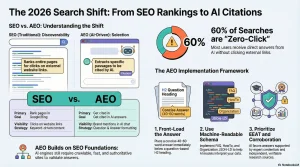
Answer engines do not “rank” content the same way traditional search engines do. They select, synthesize, and cite the source that best satisfies the user’s question.
If you want to outrank competitors and be cited inside AI Overviews, AI chat tools, and voice assistants, you must understand exactly how answer engines decide what to show and what to cite.
Below is a deeper, more technical breakdown that goes beyond surface-level advice and aligns with how modern AI systems evaluate content in 2026.
Short Answer: How Do Answer Engines Choose What to Show?
Answer engines evaluate:
- Intent match and format fit
- Topical authority and EEAT signals
- Corroboration across independent sources
- Machine-readable structure and schema
- Recency and maintenance signals
- Technical crawlability and performance
- Engagement and real-world usefulness
- Platform-specific weighting differences
They do not rely on one factor. They weigh all signals together and then select the source that appears most trustworthy, extractable, and useful.
1. How Answer Engines Interpret the User Question and Intent
Before selecting a source, AI systems must first understand the prompt.
Platforms like Google, Microsoft, and OpenAI use advanced natural language understanding models to classify:
- Is this a definition?
- Is this a step-by-step process?
- Is this a comparison?
- Is this a fact lookup?
- Is this commercial research?
Format Matching Is Critical
Once intent is classified, engines rank candidate pages based on format alignment.
For example:
- A short 40–60 word definition placed at the top of a page often wins for “What is…” queries.
- A numbered list with clear steps and HowTo schema is favored for procedural queries.
- A comparison table is preferred for “X vs Y” searches.
- A bullet summary before long content increases extraction probability.
If your answer is buried in paragraph five, you will likely lose.
Optimization Strategy:
- Mirror the user’s exact question in an H2.
- Provide a concise, direct answer immediately below.
- Expand afterward with context.
This reduces friction for the model and increases citation probability.
2. The Most Important Signals Answer Engines Use
Relevance and Exact Semantic Match
Answer engines score both keyword similarity and semantic alignment.
They evaluate:
- Exact phrasing overlap
- Contextual meaning
- Topic coverage depth
- Entity relationships
A precise answer that clearly restates the query context in the first sentence performs significantly better than vague commentary.
For example:
Weak:
“Businesses today must adapt to modern search trends.”
Strong:
“Answer engines choose sources based on intent match, authority, corroboration, schema structure, and technical health.”
The second example directly answers the question.
Authority and EEAT Signals
EEAT stands for:
- Experience
- Expertise
- Authoritativeness
- Trustworthiness
AI systems assess:
- Clear author bylines
- Author credentials
- Organization transparency
- Linked case studies
- Citations to reputable sources
- Demonstrated real-world results
Place author credentials near the top of the page.
Include measurable data.
Use method statements when referencing performance.
Engines prefer accountable, attributable content over anonymous commentary.
Corroboration and Consensus
AI models prefer answers that are supported by independent sources.
If multiple credible websites confirm a claim, the probability of citation increases.
To strengthen corroboration:
- Cite primary research.
- Link to industry studies.
- Reference official documentation.
- Avoid unsupported claims.
If your page states something unique without support, it may be deprioritized unless clearly positioned as an expert insight.
Structured Data and Machine Readability
Schema does not guarantee citation. However, it improves machine interpretability.
Common schema types used in answer engine selection:
- FAQPage
- HowTo
- Article
- Organization
- Person
Use JSON-LD.
Ensure visible content matches structured markup.
Keep answers concise and human-readable.
Even though Google limits certain rich results, structured data still improves machine parsing and non-Google AI surfaces.
3. Recency and Timeliness Signals
For evolving topics, freshness matters.
Engines evaluate:
- Publish date
- Update date
- Content revision frequency
- Clear update logs
If your competitor updated their guide last month and yours was published two years ago without revision, theirs will likely be selected.
Best practice:
- Add “Last Updated” notes.
- Include short update summaries.
- Maintain active revision cycles.
4. Technical Health and Crawlability
Even excellent content fails if it cannot be accessed.
Answer engines consider:
- Page speed
- Mobile usability
- Core Web Vitals
- Proper indexing
- Robots accessibility
- Server reliability
A slow or blocked page will lose to technically optimized competitors.
Technical health is not optional for Answer Engine Optimization.
5. User Engagement and Real-World Signals
Engines observe behavioral patterns.
They evaluate:
- Click-through rates
- Task completion indicators
- Follow-up queries
- Engagement signals
- Conversion outcomes
If users consistently return to results after visiting a page, the engine may infer dissatisfaction.
High engagement and qualified leads strengthen long-term selection probability.
Measure:
- AI Overview impressions
- Featured snippet appearances
- Zero-click visibility growth
- Assisted conversions
6. Platform-Specific Weighting: Google vs Microsoft Copilot
Different platforms weigh signals differently.
Google AI Overviews emphasize:
- Structured format
- EEAT signals
- Corroborated information
- Internal linking strength
Microsoft Copilot often:
- Cites clearly structured sources
- Rewards machine-readable formatting
- Integrates web results dynamically
Diversify your signals.
Do not optimize for one platform only.
7. Why Citations, Provenance, and Transparent Methods Matter
Answer engines prefer verifiable information.
When including case metrics or claims:
Add:
- Timeframe
- Sample size
- Tools used
- Method summary
For example:
Instead of:
“We increased zero-click visibility significantly.”
Write:
“We increased zero-click impressions by 37 percent in 60 days by restructuring FAQ sections and implementing JSON-LD FAQ schema.”
Specificity increases trust and citation likelihood.
8. How to Structure a Page So Answer Engines Choose It
Here is a structure optimized for AI selection:
Step 1: Front-Load the Answer
Provide a concise 40–60 word answer immediately under the heading.
Step 2: Add Three Supporting Bullets
Summarize the key points before expanding.
Step 3: Mirror User Questions
Use H2s that replicate real queries.
Example:
“How do answer engines evaluate authority?”
Step 4: Include a Short FAQ Section
Add query variants and implement FAQ Page schema.
Step 5: Add Author and Organization Signals
Include:
- Author name
- Credentials
- Link to bio
- Organization schema
Step 6: Demonstrate Topical Depth
Link to:
- AEO pillar content
- Related service pages
- Supporting articles
This reinforces semantic authority.
9. How to Measure If You Are Being Selected
To measure AEO performance:
Track:
- AI Overview citations
- Featured snippet placements
- People Also Ask inclusion
- Organic CTR shifts
- Zero-click impression growth
- Assisted leads and demo requests
Expect early wins within 30 to 90 days for mid-competition queries.
Highly competitive topics may require longer authority building.
How Do I Start Optimizing My Business Website for AI-Driven Search Tools Like ChatGPT and Perplexity?
Start with three steps:
Step 1: Identify Commercial Questions
For example:
- Are answer engine optimization services worth it?
- What are the best AEO platforms?
- Is AEO replacing SEO?
Step 2: Structure Answers Clearly
Answer in the first paragraph. Expand below.
Step 3: Add Authority Signals
Include:
- Expert commentary
- Clear positioning
- Data-backed statements
This makes AI systems trust your content.
Every client and brand is asking about AEO. The shift is real. AI answers influence buying decisions before clicks happen.
Businesses that implement structured, authoritative, machine-readable content now will dominate AI-driven discovery in 2026 and beyond.
If you want a structured, revenue-focused approach to Answer Engine Optimization (AEO) services designed specifically for mid-market growth, booking a strategy call with NediaDigital is the smartest next step.
AI visibility is not about gaming algorithms.It is about clarity, authority, and structure. Those who master it will not just rank. They will be cited, trusted, and chosen.
FAQs
How can agencies find affordable Answer Engine Optimization services without sacrificing quality?
Affordable AEO services should still demonstrate measurable AI visibility growth. Agencies should evaluate providers based on:
- Real AI citation tracking across platforms like ChatGPT, Perplexity, and Google AI Overviews
- Growth in zero-click impressions and featured snippet placements
- Structured content implementation such as FAQ schema and answer-first formatting
- Evidence of improvements in brand co-occurrence and topical authority
Are AEO services worth investing in?
Yes, if executed correctly. Research shows that zero-click searches now represent a significant portion of informational queries. Being cited inside AI summaries increases brand authority, even when users do not click.
Is “Answer Engine Optimization” a real strategy or just SEO renamed?
AEO builds on SEO fundamentals but introduces a different distribution goal. Traditional SEO optimizes for ranking pages. AEO optimizes for being extracted, summarized, and cited inside AI-generated answers.
Why are brands shifting focus from rankings to being the best answer?
User behavior has changed. AI tools now provide instant responses. Users expect:
- Clear answers
- Conversational clarity
- Concise summaries
Brands must focus on becoming the most trustworthy and complete answer, not just appearing in search results. Authority, corroboration, and structured clarity now influence visibility.
How does Answer Engine Optimization increase chances of AI citations?
To increase citation probability:
- Provide a direct 40 to 60 word answer under each question heading
- Use clean H2 and H3 structures
- Add FAQ schema and HowTo schema
- Ensure entity clarity
- Include data-backed statements
AI systems prefer content that is easy to parse and extract.
What are the practical steps for implementing AEO?
- Identify real user questions through Search Console and forums
- Rewrite top sections to provide rigid, factual summaries
- Use structured headings like “What is…”, “How to…”, “Why does…”
- Add structured data markup
- Build topical depth through interconnected content
- Track citation visibility across AI platforms
The process is structured and iterative.
How can YouTubers optimize for answer engines?
AI models extract information from transcripts and metadata.
YouTubers should:
- Upload full transcripts
- Use structured descriptions
- Add timestamps
- Include clear Q&A sections in video descriptions
- Machine-readable transcripts improve extractability.