
What GEO Means Alongside SEO, and Why Businesses Need Both
GEO stands for Generative Engine Optimization, the practice of optimizing for generative AI search experiences (ChatGPT, Gemini, Claude, Perplexity, AI Overviews, AI Mode, and others). It is used interchangeably with AEO (Answer Engine Optimization), and in practice the work required for both is identical.
SEO (Search Engine Optimization) is the parent discipline focused on traditional search engines, primarily Google. GEO is its child and partner, focused on AI-generated answer surfaces. Advanced solutions for businesses in 2026 treat them as one integrated program rather than two separate channels, because the underlying disciplines (content quality, technical hygiene, authoritative citations, audience understanding) are largely shared.
The businesses winning in 2026 are not those that picked one or the other. They are the ones that built combined GEO and SEO operations with shared tooling, shared analyst teams, and shared executive reporting. This article lays out what “advanced” looks like in that context.
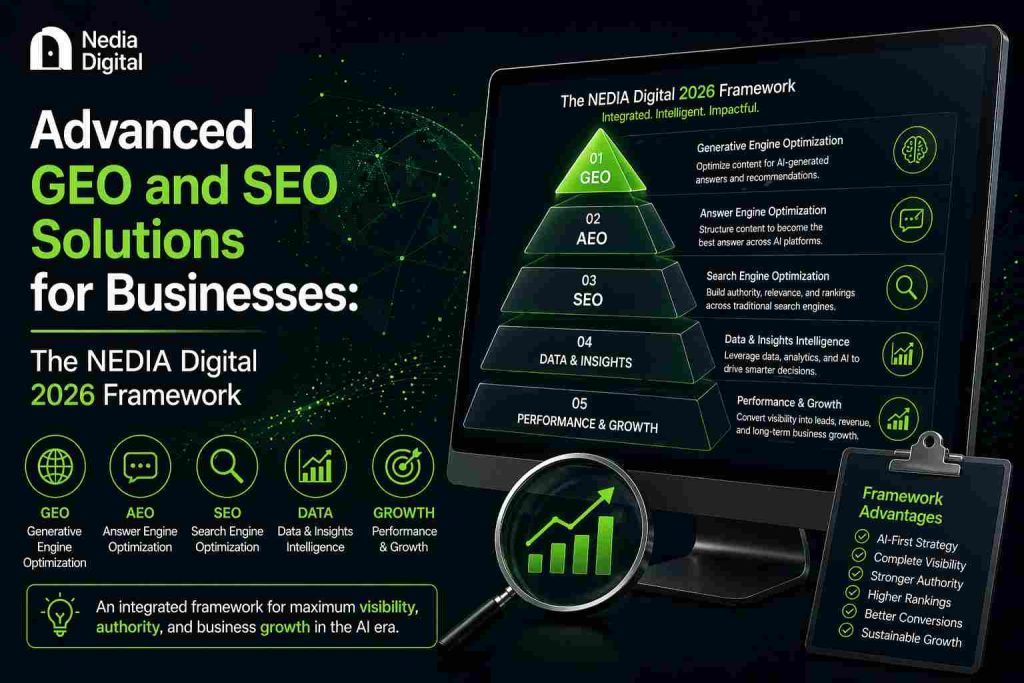
The Five Layers of an Advanced GEO and SEO Solution
- Layer one, measurement and intelligence. Combined dashboards pulling from Google Search Console, GA4, Ahrefs or Semrush, and a dedicated LLM visibility tool. Weekly and monthly reporting rhythm that surfaces trends across Google and AI in a single view.
- Layer two, content engine. A systematic approach to producing LLM-aware and Google-aware content, usually 4 to 20 pieces per month depending on scale. Content maps to prompt clusters identified through LLM visibility analysis and keyword research from traditional SEO tools.
- Layer three, citation and authority building. Reddit, YouTube, guest posts, affiliate placements, podcast appearances, and earned media on high-trust domains. Prioritized by the citation source map from the LLM visibility tool plus the backlink opportunities from Ahrefs or Semrush.
- Layer four, technical optimization. Schema markup, core web vitals, internal linking architecture, LLMS.txt deployment, subdirectory versus subdomain decisions, and site speed. These affect both Google ranking and AI citation eligibility.
- Layer five, experiment management. Controlled tests with test and control groups measuring the impact of specific interventions, with statistical rigor. This is the layer that separates advanced solutions from basic ones. Without experimentation, you are guessing.
Why Most Businesses Need Advanced Solutions, Not Basic Ones
Basic SEO worked well in 2015 when the channel was simpler and competition was thinner.
In 2026, four conditions have changed.
- Competition has grown. Every meaningful category has dozens of well-resourced competitors optimizing for search.
- The surface is fragmented. Google is no longer the only search experience. ChatGPT, Gemini, Perplexity, AI Overviews, AI Mode, Claude, and Grok all command meaningful attention. A basic solution optimizing for Google alone captures a fraction of the total opportunity.
- AI-generated content has flooded the web. Research indicates that in 2026, AI-generated content on the open internet now exceeds human-generated content in volume. This means standing out requires either genuine information gain, deep expertise, or unique original research. Generic content loses.
- Measurement complexity has grown. Tracking Google alone is one tool and one dashboard. Tracking Google plus five AI engines with statistical rigor is substantially more complex. Advanced solutions exist because the problem has grown more complex.
The NEDIA Digital Advanced GEO and SEO Framework
We apply a five-phase framework to every client engagement.
- Phase one, intelligence foundation (weeks 1 to 2). Full audit of current Google and AI visibility, prompt bank construction, competitor analysis, citation source mapping, technical SEO audit.
- Phase two, quick wins (weeks 3 to 6). Address high-priority technical issues. Publish or rewrite the 5 to 10 highest-leverage pages. Begin Reddit and YouTube engagement on priority prompt clusters.
- Phase three, systematic execution (weeks 7 to 24). Monthly content sprints (8 to 16 pieces depending on scale), continuous citation seeding, monthly technical audits, quarterly experiment design and analysis.
- Phase four, optimization and scale (weeks 25 to 52). Double down on what works, kill what does not, expand into adjacent prompt clusters, build out international or multi-language coverage where relevant.
- Phase five, moat building (year two plus). Original research, thought leadership, podcast presence, conference speaking. The work that compounds into durable category authority over multiple years.
Who Should Choose an Advanced GEO and SEO Solution
Advanced solutions are right for businesses where organic traffic is a material share of revenue or pipeline. Typical fit: B2B SaaS companies between 1 and 100 million dollars ARR, ecommerce brands above 5 million dollars in annual revenue, multi-location service businesses, professional services firms competing in crowded markets, and media and content businesses dependent on traffic.
Businesses that do not need advanced solutions yet: very early-stage startups validating product-market fit (basic LLM visibility tracking plus minimal SEO is sufficient until you know what is working), businesses in regulated industries with severe content constraints, and businesses in extremely niche categories where competition is thin enough that basic work wins.
If you are in one of the fit categories but running basic SEO alone, you are almost certainly leaving significant revenue on the table. The compounding effect of advanced solutions means the gap between advanced and basic operators widens every quarter.
What Advanced Solutions Cost (And Why They Pay Off)
Pricing for advanced GEO and SEO solutions, whether built in-house or delivered by an agency, typically ranges from 5,000 to 50,000 dollars per month depending on scale, complexity, and the level of execution required. Enterprise programs can run higher.
In-house costs: a senior SEO and AEO lead at 150 thousand dollars fully loaded, a content team of two to four people at 80 thousand to 120 thousand dollars each, outreach and community team at 70 thousand to 100 thousand dollars each, plus tooling at 500 to 2,000 dollars per month. Total annual in-house program often exceeds 500 thousand to 1 million dollars for mid-market.
Agency costs for an equivalent program: typically 15,000 to 40,000 dollars per month all-in, which is 180,000 to 480,000 dollars annually. The agency option is usually more cost-effective for businesses below about 50 million dollars in revenue because the specialization and tooling costs are amortized across multiple clients.
ROI timeframes: expect 6 to 12 months before the program is paying for itself through attributed pipeline or revenue. Programs that deliver faster are either lucky or cutting corners; programs that take longer are either underfunded or poorly executed.
What Advanced Programs Actually Deliver in Months One Through Twelve
Realistic expectations matter. Here is a month-by-month view of what well-executed advanced GEO and SEO programs typically deliver, based on dozens of NEDIA Digital client engagements.
- Month one. Foundational audit completed. Prompt bank built (150 to 300 prompts). Baseline measurements across five to six AI engines and all major Google query categories. Technical SEO quick wins shipped. First two to three priority content pieces published. Reddit and YouTube channels established or activated. No meaningful visibility movement yet. The first month is foundation work.
- Months two to three. First measurable visibility gains on priority prompt clusters (typically 3 to 8 percentage points on share of voice). First organic ranking movements on priority Google keywords (typically incremental, not dramatic). First earned citations appearing in AI answers from the month-one content and outreach. Program rhythm established: weekly reports, monthly deep-dives, quarterly roadmap reviews.
- Months four to six. Share of voice gains of 10 to 20 percentage points on priority prompts becoming clear. Google ranking gains starting to compound (pages ranking 6 to 15 moving into top 5, category keywords in top 20 moving into top 10). First attributable pipeline starting to flow through from AI channels. Content library reaching the 20-to-40-piece mark where thematic authority becomes measurable.
- Months seven to nine. Share of voice gains plateauing on easy-win prompts, creating capacity to pursue harder prompts. Google rankings stabilizing at new higher positions. Competitive pressure emerging as competitors notice and respond to your visibility gains. Time to double down on moat-building content (original research, thought leadership, podcast appearances).
- Months ten to twelve. Year-one results quantified. Typical outcomes: 20 to 45 percentage point share of voice gains on priority prompt clusters, 30 to 80 percent organic traffic growth from Google, meaningful LLM-attributed pipeline. Year-two roadmap built based on year-one data.
Compounds continue into years two and three, where well-run programs often outpace paid channels on cost per acquisition. The ROI curve is backloaded. Patience and consistency are the main success predictors.
Engage NEDIA Digital for Your Advanced GEO and SEO Program
NEDIA Digital specializes in advanced GEO and SEO solutions for businesses ready to move beyond basic work. Our engagements typically run 12 to 24 months because the compounding work of advanced SEO and AEO takes time to fully deliver.
Every client starts with a free strategic audit covering current Google and AI visibility, competitor positioning, citation gap analysis, content gap analysis, and technical foundation review. We deliver the audit as a 20 to 30 page report plus a live walkthrough, and we share it whether or not you ultimately engage us.
If you decide to engage, we staff a named analyst lead, a content team sized to your scope, a community and outreach team, and a technical SEO resource. The team works inside your existing project management tools, reports to you weekly and monthly, and is fully accountable to the scorecard metrics we agree on at kickoff.
Book your free strategic audit with NEDIA.
We run a limited number of new audits each quarter to keep quality high, and the slots fill quickly. Advanced GEO and SEO is a compounding game. The earlier you start, the wider your lead compounds. Every month you wait is a month your competitors extend theirs.