
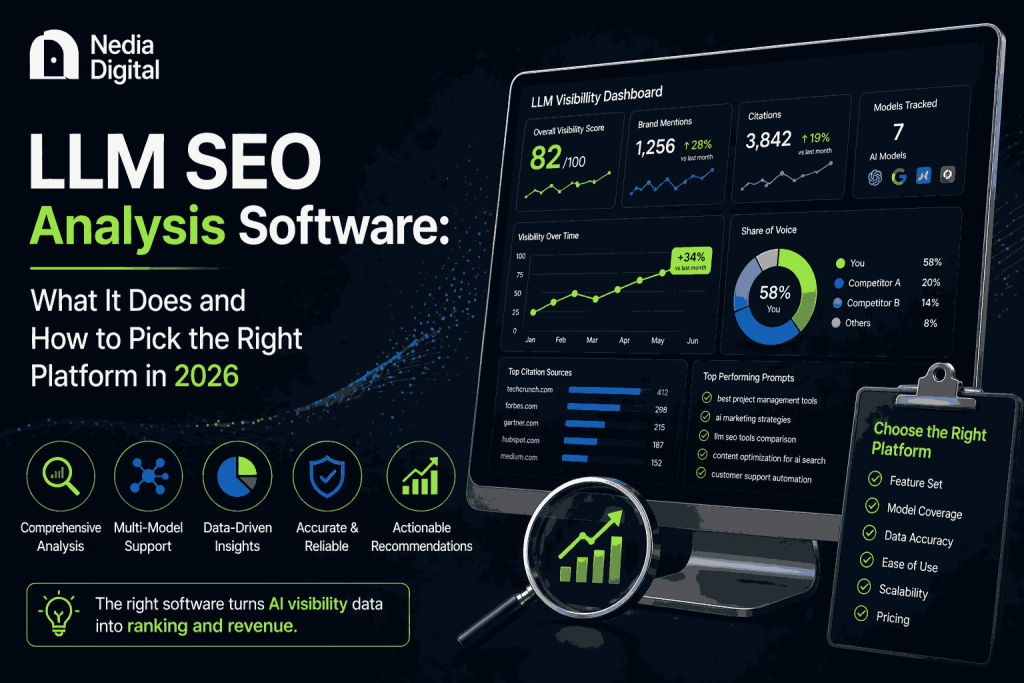
What Is LLM SEO Analysis Software?
LLM SEO analysis software is a category of platforms that ingest your brand’s AI visibility data and turn it into insight. The difference between a raw tracker and analysis software is the same as the difference between a thermometer and a doctor’s diagnosis. The thermometer tells you the temperature. The diagnosis tells you what is wrong and what to do about it.
In practical terms, LLM SEO analysis software combines prompt-level checking, citation source mapping, competitor benchmarking, sentiment analysis, content gap identification, and prioritized recommendations into a single workflow.
The best tools let a marketing operator walk in Monday morning, open the dashboard, and have a clear picture of where to spend the week’s content and outreach budget without needing to do the analysis themselves.
The Capabilities That Matter in LLM SEO Analysis Software
- Start with data coverage
The software must pull data from every AI engine that matters to your buyers, which in 2026 means at minimum ChatGPT, Google AI Overviews, Google AI Mode, Gemini, Perplexity, and Claude. Skipping any of these leaves blind spots. DeepSeek and Grok matter for specific regions and audiences.
- Prompt Intelligence
Software that forces you to manually enter every prompt is a mid-2024 tool. Modern analysis software auto-generates fan-out prompts from your seed keywords using actual conversational patterns, so you are not optimizing for prompts your customers never type.
- Citation source analysis
Any serious tool can tell you who got cited. The good ones tell you which subreddit, which Forbes article, which YouTube video, and which G2 review is doing the heavy lifting. That level of granularity makes outreach planning concrete.
- Competitive benchmarking with overlap analysis
You want to see not just your rank-ordered competitor list but a Venn diagram showing which prompts are yours, which are theirs, and which are contested.
- Sentiment decomposition with examples
A raw “45 percent positive, 30 percent neutral, 25 percent negative” line is less useful than sentiment broken out by prompt cluster with quoted response snippets so you can verify the classifier’s accuracy.
- Content gap recommendations tied to your on-site content inventory
The software should know what you have published and identify topics where you have no coverage but the AI is regularly asked questions.
How to Evaluate LLM SEO Analysis Software Without Falling for Marketing
Vendor demos are designed to wow, not inform. Impose discipline on your evaluation with a four-step test.
- Step one: Bring your own prompt bank. Load 50 of your actual prompts, not the vendor’s pre-baked demo prompts, and see how the platform handles them.
- Step two: Check sample size honesty. Ask the vendor how many runs per prompt per model per day the tool performs. If the answer is less than five, the reported numbers are statistically noisy. If they cannot answer, that is a red flag.
- Step three: Inspect the citation sources list. Pull up a recent report and scroll the citation sources. Are they real, fresh URLs with working links, or do you see stale or hallucinated sources? Tools vary widely here.
- Step four: Compare two tools side by side for two weeks. Run the same prompt bank through two tools and see which gives you more actionable insight. One tool will usually win clearly. That is the one you buy.
Common Pitfalls When Deploying LLM SEO Analysis Software
Here are some common pitfalls to avoid when deploying LLM SEO analysis software:
1. Buying before you have a prompt bank
Software is useless without the questions you want answered. Spend two weeks building a prompt bank of 100 to 300 queries before you shop.
2. Choosing a tool that covers too many engines you do not care about
If your customers never use Claude, paying for Claude tracking dilutes your budget. Match tool coverage to buyer behavior.
3. Ignoring the human operator layer
The software generates insight, but someone has to read it, translate it into actions, and coordinate the execution.
If you do not have that person internally, either hire one or hire an agency like NEDIA Digital to run the operating layer for you.
4. Setting unrealistic timelines
Moving share of voice meaningfully takes 60 to 90 days in most categories. Judging the software after 30 days is premature. Commit to a full quarter before evaluating outcomes.
Integrating LLM SEO Analysis Software with Your Existing SEO Workflow
The integration question comes up in almost every sales conversation because most buyers already own Ahrefs, Semrush, Google Search Console, and a content CMS. They reasonably ask whether they need yet another tool, and how it fits with what they already have.
The honest answer is that LLM SEO analysis software does not replace any of your existing tools. It adds a new layer. Google Search Console remains your source of truth for Google indexing and query data. Ahrefs or Semrush remain your source for keyword research and backlink intelligence. Your CMS remains where content is produced and managed.
LLM SEO analysis software sits on top of all of this, pulling prompt-level visibility data from AI engines and cross-referencing it against the citations, keywords, and backlinks in your traditional SEO stack.
The integration points that matter most are CSV or API export from the LLM tool into your BI dashboard, webhook-based alerts that fire into Slack or Asana when share of voice shifts, and manual cross-referencing between citation source lists and your outreach tool.
The Analyst Skills Required to Get Value from This Software
One reason LLM SEO analysis software underperforms expectations is that buyers underestimate the analyst skills required to operate it well. The software generates data. Someone has to interpret that data and translate it into actions.
The core analyst skills are:
- prompt engineering (knowing how real users phrase queries in ChatGPT versus Google)
- statistical literacy (reading confidence intervals and understanding sample size)
- competitive intelligence (recognizing which competitors are worth tracking and why)
- content strategy (translating a visibility gap into a specific content brief),
- outreach planning (knowing which Reddit thread, YouTube creator, or affiliate placement is worth pursuing).
Few marketing generalists have all five of these skills at a senior level. The shortlist of roles that combine them includes experienced SEO leads with content background, senior growth marketers, and dedicated AEO analysts (a role that barely existed 18 months ago but is becoming standard at mid-market and enterprise companies).